Math
Percentage calculator
Choose the kind of percentage question, enter the two numbers, and read off the answer with the working. Six calculations cover almost every percentage problem, from a tip to a price before tax.
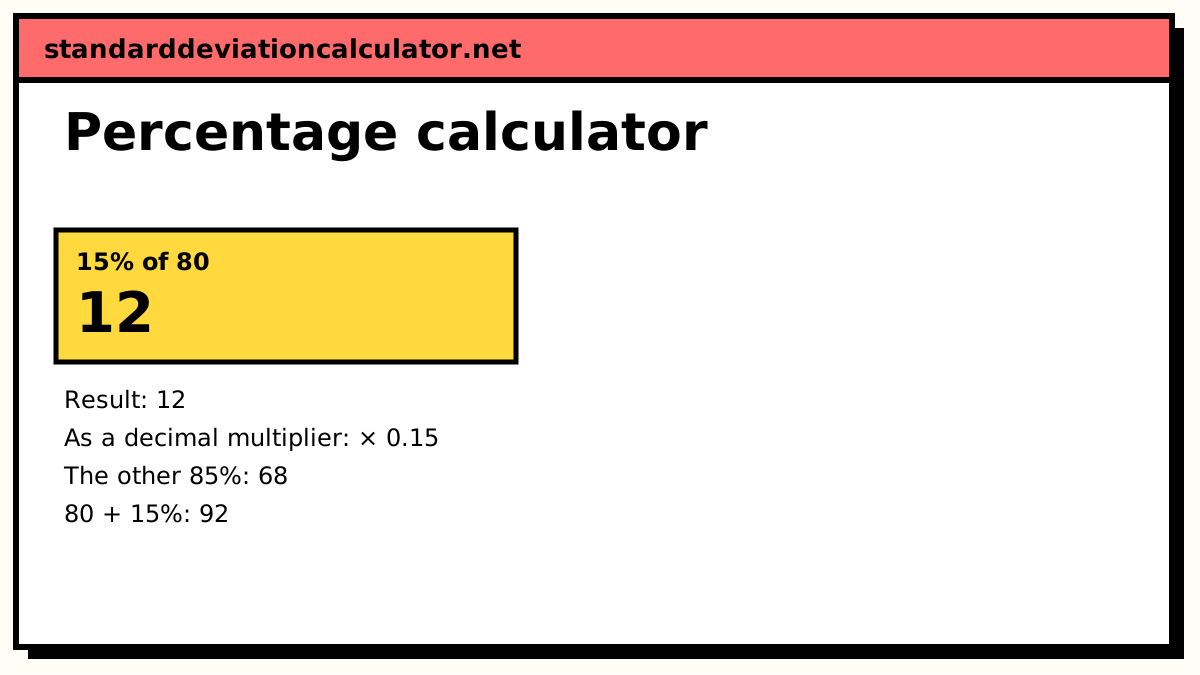
15%: 12 (15%) rest: 68 (85%)
Show the working, step by step
Percent means “per hundred”, so turn the percentage into a decimal by dividing by 100.
15% = 15 ÷ 100 = 0.15
Multiply the number by that decimal.
0.15 × 80 = 12
Shortcut: X% of Y equals Y% of X, so 15% of 80 is the same as 80% of 15.
The formulas
| Question | Formula | Default example |
|---|---|---|
| What is X% of Y? | X ÷ 100 × Y | 15% of 80 = 12 |
| X is what % of Y? | X ÷ Y × 100 | 18 of 72 = 25% |
| Change from X to Y | (Y − X) ÷ |X| × 100 | 250 → 310 = +24% |
| Y increased by X% | Y × (1 + X ÷ 100) | 1,200 + 8% = 1,296 |
| Original before an X% rise | final ÷ (1 + X ÷ 100) | 126 after +20% → 105 |
| Percentage difference | |X − Y| ÷ ((X + Y) ÷ 2) × 100 | 40 and 60 → 40% |
“Per cent” means per hundred, so every formula either divides by 100 to turn a percentage into a decimal, or multiplies by 100 to turn a decimal into a percentage.
A worked example
The calculator opens on 15% of 80. Divide 15 by 100 to get 0.15, then multiply: 0.15 × 80 = 12. The other 85% is 68, and 80 increased by 15% is 92.
Multipliers make chains easy
An increase of 8% is the same as multiplying by 1.08; a decrease of 8% is multiplying by 0.92. Thinking in multipliers helps with several changes in a row: a price that rises 10% and then falls 10% ends at 1.10 × 0.90 = 0.99 of where it started, a 1% loss, not zero. It also explains reverse percentages: to undo “× 1.20” you divide by 1.20.
Which number is the base?
Nearly every percentage mistake comes from dividing by the wrong number. The base is the value the percentage is “of”: the old value for a change, the whole for a share, the original price for a discount. When a question says “a 20% increase gave 126”, the base is the unknown original, not 126.
Percentages, fractions and decimals
| Percentage | Decimal | Fraction |
|---|---|---|
| 1% | 0.01 | 1/100 |
| 12.5% | 0.125 | 1/8 |
| 20% | 0.2 | 1/5 |
| 25% | 0.25 | 1/4 |
| 33.33…% | 0.333… | 1/3 |
| 75% | 0.75 | 3/4 |
| 150% | 1.5 | 3/2 |
Knowing a few of these makes mental estimates quick: 25% of 72 is a quarter of 72, which is 18, the reverse of the “18 is what percent of 72?” example.
Common mistakes
- Subtracting the percentage to reverse it. 126 − 20% = 100.8, but the original was 105.
- Adding successive percentages. +10% then +10% is +21%, not +20% (1.1 × 1.1 = 1.21).
- Dividing by the new value for a change. 250 → 310 is +24% of 250, not 60 ÷ 310 = 19.35%.
- Mixing up percent and percentage points. See the FAQ below.
Common questions
How do I calculate a percentage of a number?
Divide the percentage by 100 and multiply: 15% of 80 = 0.15 × 80 = 12. A handy check is that X% of Y equals Y% of X, so 15% of 80 is also 80% of 15, which is 12.
How do I work out a percentage increase or decrease?
Subtract the old value from the new one, divide by the old value, and multiply by 100. From 250 to 310: (310 − 250) ÷ 250 × 100 = 24%, an increase. A negative answer is a decrease.
Why is a 24% rise not undone by a 24% fall?
Because each percentage is taken of a different base. 250 up 24% is 310, but 310 down 24% is 235.6. To get back from 310 to 250 you need a fall of 60 ÷ 310 = 19.35%.
How do I find the original price before a percentage change?
Divide by the multiplier rather than subtracting the percentage. If a price is 126 after a 20% rise, the original is 126 ÷ 1.20 = 105. Taking 20% off 126 gives 100.8, which is wrong because the 20% was 20% of 105, not of 126. The same applies to removing sales tax or VAT from a price.
What is the difference between percentage change and percentage difference?
Percentage change measures from a starting value: 40 to 60 is a 50% increase. Percentage difference compares two values with neither as the base, dividing by their average: |40 − 60| ÷ 50 = 40%. Use change for before-and-after, difference for two measurements side by side.
What is the difference between percent and percentage points?
A rate going from 4% to 5% has risen by 1 percentage point but by 25 percent, because 1 is a quarter of 4. News reports mix these up often, so check which one is meant.
Related calculators
-
Ratio and proportion
Shares of a whole as ratios instead of percentages.
-
Percentile
The value below which a given percentage of data falls.
-
Division
Exact decimals, including repeating ones.
-
Compound interest
Percentage growth applied again and again.